
01
Stage before status
Language, complexity, pressure and training dose follow the player’s development—not the level printed beside their name.
The task is challenging, understandable and repeatable at the player’s current stage.
The DTHA Development Model
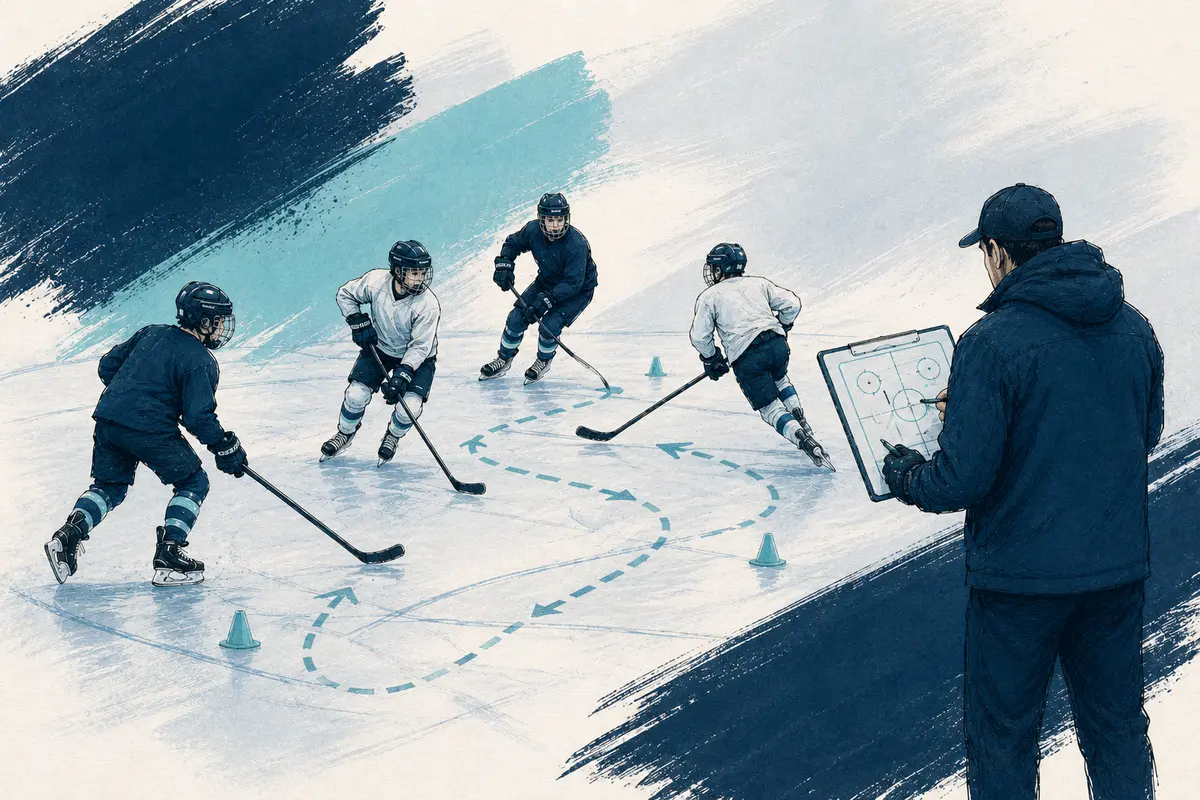
DTHA combines what leading hockey systems share: put the player first, match the task to the stage, create meaningful repetitions and return every improvement to a real game situation.
The service, age and exact content may change. These standards do not. They keep development specific, humane and connected to performance.
A drill is a delivery tool. The real product is a player who recognizes the problem, selects a response and can adapt it when the game changes.
Language, complexity, pressure and training dose follow the player’s development—not the level printed beside their name.
Technique is connected to scanning, timing, space, teammates and opponents so the player learns when to use it.
Stations, small groups and adapted game formats protect meaningful involvement within limited practice time.
Questions and constraints guide exploration without making every decision for the player.
Clear priorities and process-focused feedback turn development into something visible and owned.
Respect, recovery and psychological safety are performance conditions—not extras added after training.
Move through the five steps below. Hover or choose a step to see what changes for the coach, the player and the evidence of progress.
What repeats in games—and what information is available before it happens?
Observe complete situations, ask for the player’s view and separate the root constraint from the visible outcome.
Describe what they saw, expected and tried before receiving a correction.
The same problem appears across more than one shift, practice or comparable situation.
One clip, one mistake or one bad day is not a diagnosis.
Skill is introduced at the simplest useful level, then connected to perception, choice and consequence. If quality collapses, the task is adjusted. If success requires no read, the task needs better information.
Read the IIHF teaching frameworkDefine the repeated situation, the player’s current view and the consequence that matters.
Reduce complexity long enough to improve balance, timing, control and confidence.
Introduce a visual cue, another option, changing space or a teammate before adding chaos.
Use realistic speed, opposition, score, traffic or time so the solution must adapt.
Verify the behaviour in competition, review what the player noticed and set the next priority.
These phases translate public development guidance into DTHA coaching priorities. They are planning benchmarks—not a diagnosis. Maturation, experience, health, motivation and total load still matter.
Broad movement, joy and puck familiarity come first. Explanations stay short and players spend far more time doing than waiting.
Strong fundamentals still lead. Simple decisions are layered onto skating and puck actions without narrowing the child too early.
Technique begins to connect with individual tactics, teammates and changing space while growth and confidence remain visible.
Position context, pace and team concepts grow, but maturation differences mean one uniform dose is not responsible coaching.
Role detail, pace and physical preparation become more individual while technical work remains part of the weekly plan.
The plan narrows to the few changes with the greatest performance value and coordinates hockey, recovery, education and the next opportunity.
A responsible academy coordinates performance with health, recovery, education and future readiness. One area should not quietly damage the others.
Efficient skill and role detail that survive game speed, pressure and consequence.
The ability to scan, choose, reflect and solve without waiting for the coach’s answer.
A workload the athlete can absorb alongside growth, team activity, health and sleep.
School, communication and future planning remain part of a sustainable athlete pathway.
DTHA feedback identifies a visible cue and a controllable action. It should help the player notice earlier—not make the player dependent on a louder coach.
“Be faster.”
“Scan before your inside edge lands so the next route is already available.”
“Work harder.”
“Win body position first, then recover your stick through the puck.”
“Do not turn it over.”
“Keep two exits until the defender commits; then protect the option they remove.”
DTHA is independently operated. These links show the public material behind the model; citation does not imply affiliation, certification, partnership or endorsement.
Player-centred, age-appropriate development and public age-division benchmarks.
Open original sourceSkill, physical development, planning, well-being, lifestyle and parent support.
Open original sourceAge-specific practice design with game-like, high-repetition learning environments.
Open original sourceHuman-centred, inclusive and varied development within the athlete’s environment.
Open original sourceEvidence on player involvement, puck actions and decisions across adapted game formats.
Open original sourceChildren’s priorities include effort, learning, positive coaching, team connection and sportspersonship.
Open original sourceDTHA will identify the most useful starting point, explain the reasoning and recommend only the service the situation earns.